A sales head asks why three of the last five hires left within a year. The recruiter in the room already knows the answer. Those candidates were hired in record time, against a pay band that had not moved in two years, for a role whose real targets were never mentioned in the interview.
The recruiter spotted the problem at the offer stage. Nobody asked, because the conversation was happening between the sales head and the HR business partner, and the recruiter was on the other side of the table.
That gap between knowing and being asked is where many HR recruiter jobs quietly stall. It is also the strongest argument for moving into a business partner role. Recruiters spend their days inside the business’s hardest people problems: where talent is scarce, what pay actually clears the market, which managers close candidates and which ones lose them.
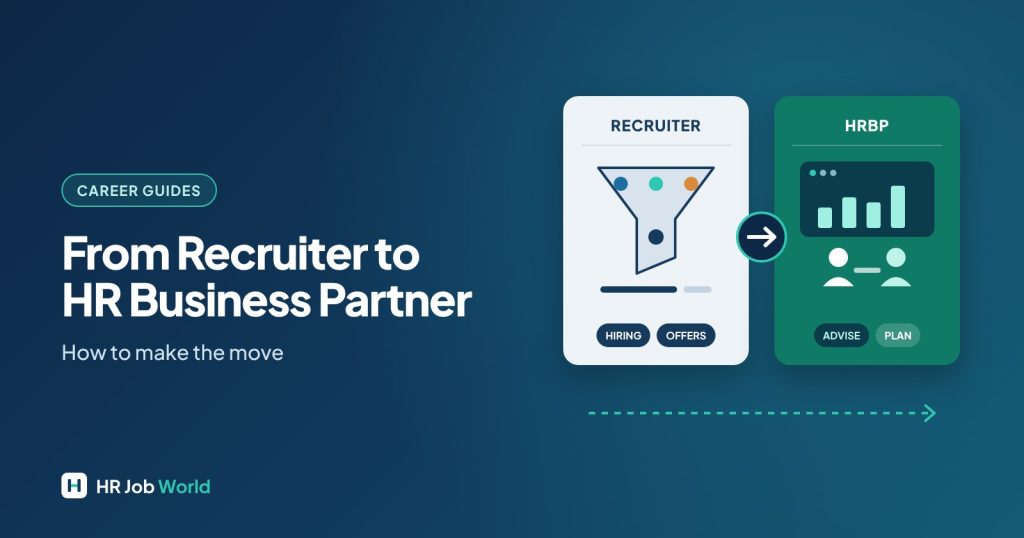
HR business partner jobs are built around advising on exactly those problems. The move is smaller than it looks, but it does not happen automatically, and the people who make it well tend to do a few specific things differently.
The short answer: recruiters already know the talent market and the hiring managers, which is half of an HRBP’s job. The other half (employee relations, performance management, workforce planning and business literacy) usually takes eighteen months to three years to build, often through an embedded talent partner or HR generalist role first.
Why Recruiters Make Natural Business Partners, and Why Many Get Stuck
The HR business partner model is usually traced to Dave Ulrich, who argued in the late 1990s that HR should work as a strategic partner to business leaders, not just as an administrative function. In practice, an HRBP sits with a business unit or function and advises its leaders on workforce planning, organisation design, performance, engagement, and employee relations.
Recruiters already have half of that picture. They know the talent market better than almost anyone in the company; they have credibility with hiring managers, and they are used to working to the business’s deadlines. A good recruiter can tell a manager that the role as written will not attract anyone at the budgeted salary, and that skill is exactly what business partnering needs.
The trouble is how recruitment work is measured. Time to fill, offers closed, and cost per hire reward speed and volume. HRBP work is measured on retention, capability, and how well a team performs over a year or two. Employers hiring for HR business partner jobs are often cautious about recruiter profiles for a simple reason: many have never run a performance improvement plan, handled a grievance, or sat through a restructuring discussion. Those are the situations where an HRBP earns trust, and a resume that shows only hiring gives no evidence either way.
What Actually Changes in the Day-to-Day
A recruiter receives a requisition and fills it. A business partner looks at the same requisition and asks whether the role is needed at all, whether someone internal could grow into it, and what the attrition history in that team says about why the seat keeps opening.
The rhythm of the week changes too. Recruiting work is driven by open roles and interview calendars. Business partnering is driven by the business’s own cycle: quarterly planning, appraisal season, a reorganisation, a manager who is losing their team. Much of the work happens in conversations with leaders, where the HRBP is expected to give a clear point of view on a people issue, sometimes one the leader does not want to hear.
That last part is the real shift. A recruiter mostly serves a request. A business partner is expected to challenge it, politely and with evidence.
The Skills Gap to Close Before Applying
Most recruiters moving into HR business partner jobs need to build depth in five areas.
- Employee Relations and Labour Law Basics: Disciplinary processes, grievance handling, POSH compliance, and the shift to India’s new Labour Codes all land on an HRBP’s desk. Even a working knowledge, backed by exposure to a few real cases, makes a visible difference in interviews.
- Compensation and Performance Management: Business partners are asked about pay parity, increment cycles, and rating calibration constantly. Recruiters already understand market pay; the new learning is internal equity and how reviews actually run.
- Workforce Planning and Organisation Design: This means reading headcount plans, understanding span of control, and knowing when a team structure is the real problem.
- Business and Financial Literacy: An HRBP who can read a P&L, understand how a unit makes money, and link a people decision to a number is taken far more seriously by leaders.
- Data Skills: Attrition analysis, hiring funnel reports, and engagement scores are now standard HRBP tools. Comfort with Excel and an HRMS reporting module is the baseline.
Stepping Stones That Actually Work
Jumping straight from recruiter to HRBP does happen, but it usually takes a bridge. The most common bridges are worth knowing.
One is becoming the embedded talent partner for a single business unit, which builds the relationship and the business context at the same time. Another is a stint in an HR generalist role covering a business unit, often for twelve to twenty-four months, which adds employee relations, performance cycles, and engagement work to the resume. A third is volunteering for the work around the edges of a current role: onboarding design, attrition analysis, exit interview themes, or inputs into the annual headcount plan. How the generalist, HR manager and HRBP titles differ is covered in HR Generalist vs HR Manager vs HRBP.
A realistic timeline for most people is somewhere between eighteen months and three years from the point of deliberately building these skills. Faster moves tend to happen in growing companies, where HR teams are small and a capable recruiter can be handed a business unit.
What the Move Pays in India
Pay data for HRBP roles varies widely depending on the source, which is worth knowing before negotiating. Comparing each source with itself gives the clearest picture of the step up.
Payscale, which collects self-reported salaries, puts the average recruiter in India at about INR 4 lakh a year (248 profiles, August 2026) and early-career HRBPs at an average of about INR 7 lakh (142 profiles, September 2026). HRBPs with business strategy skills average about INR 11.5 lakh at mid-career and about INR 19 lakh once experienced, although those two samples are small.
Other surveys report higher numbers. Keka’s HR Pay Pulse Report 2026, created with SHRM India from 1.84 lakh salary data points across more than 600 companies, shows a median of INR 12 lakh for executive recruiter and talent acquisition roles, against INR 15 lakh for junior HRBP roles (mostly INR 12 to 19 lakh) and INR 32 lakh at HRBP or senior HRBP level. It also notes premiums in hi-tech and BFSI. The gap between sources mostly reflects employer type, so larger employers and certain industries pay noticeably more for the same title.
The more reliable pattern is the trajectory. HRBP pay climbs steeply with seniority, and the skills that drive it are strategic business partnering, workforce analytics, and change management.
Repositioning the Resume and the Interview
Recruitment achievements need to be rewritten on the resume as business outcomes. A line such as “closed 120 positions in a year” says nothing about advisory ability. A line showing that a change in screening criteria for a sales team improved first-year retention says a great deal. Only claim outcomes that are real, and attach numbers wherever possible.
In interviews for HR business partner jobs, expect scenario questions: a manager wants to exit an underperformer quickly, two teams conflict, an employee raises a pay parity complaint. The strongest answers describe how the situation was understood first, who was consulted, what the risk was, and what was recommended. Two or three real stories where the work went beyond hiring are worth preparing in advance.
Where to Look
Current openings are listed under HR business partner jobs on HR Job World (973 live roles on 25 November 2026), which also helps in checking which skills employers repeat in their job descriptions. Since business partner roles are usually onsite or hybrid, the same team’s free newsletter for onsite and hybrid HR jobs sends fresh openings across HR functions straight to the inbox. Anyone open to working from anywhere can also subscribe to the HR Jobs Hub newsletter, which covers remote HR jobs from around the world.
The Move Is Really About Being Asked
A recruiter who knows why people leave, what the market pays, and where managers go wrong already holds the raw material of a business partner. The move is about building the missing pieces (employee relations, performance, planning, and business sense) and then putting oneself in the rooms where those conversations happen. Once that happens, the question stops being whether to step into the room and becomes what to say when asked.
Frequently asked questions
Can a recruiter become an HR business partner without working as a generalist first?
It is possible, mostly in smaller or fast-growing companies where HR teams are lean and a strong recruiter can be given a business unit. In larger organisations, a generalist or embedded partner stint is the usual route because it builds employee relations and performance management exposure that HRBP interviewers look for.
Do HR business partner jobs require an MBA?
Many employers prefer an MBA or PGDM in HR, but strong experience often carries equal weight, particularly for candidates who can show real casework and business impact. A degree helps at the screening stage, while stories from actual work decide the interview.
How long does the move from recruiter to HRBP usually take?
Most people need between eighteen months and three years of deliberate skill building and role changes. The timeline shortens in companies where the HR team is small and the recruiter already has strong relationships with business leaders.
Is it worth leaving HR recruiter jobs for an HRBP role?
For most people, the long-term answer is yes, because HRBP pay and scope grow faster with seniority. The trade-off is that early HRBP work can feel less measurable than recruiting, so it suits people who want to influence how a business runs and are comfortable with slower, less visible outcomes.