Most HR teams in India now run on software. Hiring happens in an applicant tracking system, attendance and leave sit inside an HRMS, payroll runs on a platform, and performance reviews live in a cloud tool. Somebody has to set up, maintain and make sense of all of it.
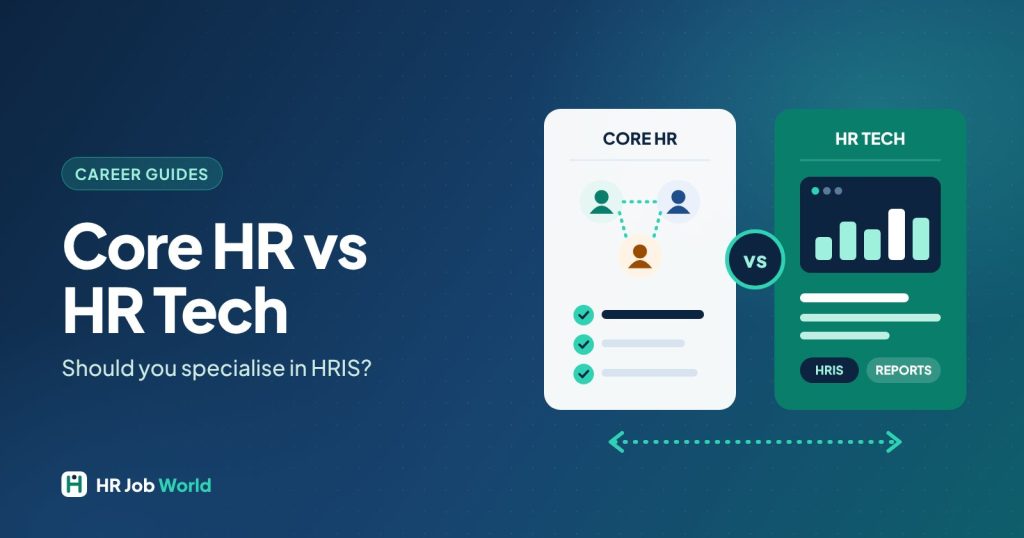
That somebody is increasingly an HR professional with technology skills, which is why HR tech jobs have become one of the most talked-about specialisations in HR. For anyone building an HR career in India, the question is a fair one: stay in core HR, or move towards HRIS and HR technology?
The short answer: core HR and HR tech are two sides of the same function, and neither is the better career for everyone. HRIS suits people who like processes, systems and data, and the salary data available points to higher pay for platform skills: Payscale puts the average HRIS analyst in India at about ₹8 lakh a year, against about ₹4.5 lakh for an HR generalist, though the HRIS figure rests on a small sample. Core HR is still the usual route to HR business partner and HR leadership roles. The low-risk way to decide is to take on HRIS work in your current job first.
What is core HR and what is HR tech?
Core HR covers the people-facing and policy-facing work of the function: recruitment, onboarding, employee relations, engagement, performance management, compensation and compliance. The work is about judgment, conversations and decisions about people.
HR tech, often called HRIS (human resources information systems), covers the systems that run those processes. It includes selecting and implementing platforms, setting up workflows, managing employee data, building reports, connecting HR tools with payroll and finance, and keeping everything accurate and secure. Our guide to HRMS and HCM software compares the main platforms.
The two are closely linked. A core HR professional uses the system every day. An HRIS professional makes sure the system works the way HR needs it to. Moving from one to the other is common, and many HRIS professionals learn HR processes first and the technology second.
Why demand for HR tech skills is rising in India
Several shifts are pushing demand for HR tech skills.
Many Indian companies have moved from spreadsheets to cloud HRMS platforms such as Darwinbox, Keka and greytHR, while larger organisations and global capability centres run enterprise platforms like Workday and SAP SuccessFactors. Each platform needs people who can implement, administer and improve it.
HR is also expected to work with data. Attrition trends, hiring funnels and workforce cost reports all depend on clean, well-structured HR data, and HRIS professionals are the ones who make that possible.
Data protection adds another layer. The rules under India’s Digital Personal Data Protection Act, 2023 were notified in November 2025 and its obligations are being phased in. Employee records are personal data, so handling them carefully is now a compliance matter, not just good practice. Professionals who understand both HR data and system security are valuable.
Common HR tech roles
- HRIS analyst: the most common entry point. Analysts handle data maintenance, report building, user support and system testing. The role suits HR professionals who enjoy structured problem-solving. Our HRIS analyst career guide covers the job in detail.
- HRIS specialist or administrator: a more hands-on technical role covering set-up, workflows and troubleshooting within a specific platform.
- HR technology consultant: works on implementations and upgrades, often at consulting firms or software vendors, turning HR processes into system set-up.
- HRIS manager: owns the HR technology roadmap, manages vendors and a small team, and works with HR leadership, IT and finance on system strategy.
Core HR vs HR tech: salary comparison in India
The salary data that is public points to higher pay for HR tech roles than for core HR roles at a similar level. The table shows base salaries per year from Payscale and Salary.com, with the size and date of each sample.
| Role | Pay in India, per year | Source |
|---|---|---|
| HRIS analyst | Average about ₹8 lakh. Most earn between about ₹2 lakh and ₹10 lakh | Payscale, 12 salary profiles, updated March 2026 |
| HRIS analyst with Workday skills | Average about ₹8.8 lakh. The middle half earn between about ₹4.8 lakh and ₹10 lakh | Payscale, 9 salary profiles, updated August 2023 |
| HRIS manager | Median about ₹16.4 lakh. The middle half earn between about ₹13.7 lakh and ₹20.7 lakh | Salary.com, as of April 2025 |
| HR generalist | Average about ₹4.5 lakh. Most earn between about ₹2.2 lakh and ₹10 lakh | Payscale, 586 salary profiles, updated August 2026 |
| HR manager | Average about ₹8.5 lakh. Most earn between about ₹3.2 lakh and ₹20 lakh | Payscale, 1,078 salary profiles, updated October 2026 |
Pay rises with experience on the HRIS path. Payscale shows mid-career HRIS analysts about 13% above the average and late-career analysts about 49% above it, which works out at roughly ₹9 lakh and ₹12 lakh a year.
Read these as rough guides, not offers. The HRIS figures come from very small samples, the Workday figure dates from 2023, and Salary.com and Payscale collect their data differently, so the two manager rows are not a like-for-like comparison. Actual pay varies by city, company and platform.
Core HR has more openings and a wider ladder. On HR Job World on 19 November 2026 there were 611 live HRIS and HR tech jobs, against 755 HR generalist jobs and 1,168 HR business partner jobs. Neither path is a clear winner. The better question is which one fits how you like to work.
Skills that HR tech employers look for
- Platform knowledge: hands-on experience with at least one major system. Workday is named in 373 of the 599 HRIS adverts we analysed on HR Job World on 17 November 2026, SAP SuccessFactors in 46 and Oracle in 26. Most of those adverts are for roles in the USA. In India, Darwinbox, Keka and greytHR are widely used alongside them.
- Data and reporting: advanced Excel is the baseline and is named in 331 of those 599 adverts. Power BI is named in 66 and Tableau in 28. SQL also helps a candidate stand out.
- Process thinking: the ability to map an HR process step by step and turn it into system logic.
- Data privacy awareness: understanding how employee data should be stored, accessed and shared.
- Communication: HRIS professionals translate between HR, IT and finance teams, so explaining technical issues in plain language matters.
Who should specialise in HRIS, and who should stay in core HR?
HRIS tends to suit people who enjoy fixing processes, like working with data and are comfortable spending more time with systems than in employee conversations. It also suits HR professionals who want a clear technical skill set that travels across industries.
Core HR suits people who find employee relations, talent and business partnering more energising. The path to HRBP and HR leadership roles usually runs through core HR experience. Our comparison of the HR generalist, HR manager and HRBP roles explains how those titles differ.
A practical middle route also exists. Many HR professionals build HRIS skills while staying in a generalist or specialist role, and then decide. Volunteering for a system rollout, owning HR reporting or becoming the point person for the HRMS are low-risk ways to test the fit.
How to start moving into HR tech
- Get hands-on with a platform. Use the system already in place at work, or a demo or trial environment.
- Build reporting skills. Start with advanced Excel, then move to a BI tool such as Power BI.
- Take a platform certification where one is open to you. Hands-on experience still counts for more with employers.
- Apply for entry-level analyst roles. Most moves into HR tech begin there. Browse the live HRIS analyst jobs on HR Job World to see which platforms and skills employers ask for before you pay for a course. Many of the roles listed are in the USA, so read the location line before you apply.
For remote and global HR roles by email, the free HR Jobs Hub newsletter is a useful way to keep the wider market in view.
The bottom line
Core HR and HR tech are not rival careers. They are two sides of the same function, and strong HR professionals usually understand both. HR tech offers a clear skill set and, on the data available, higher pay for platform expertise. Core HR offers more openings and a direct route to people leadership.
The right choice depends on which kind of work feels more rewarding day to day. Testing HRIS work in your current role is the cheapest way to find out.
Frequently asked questions
What are HR tech jobs?
HR tech jobs are roles that manage the systems HR teams use, including HRMS and HRIS platforms, applicant tracking systems and payroll tools. Common titles include HRIS analyst, HRIS specialist, HR technology consultant and HRIS manager.
What does an HRIS analyst do?
An HRIS analyst maintains employee data, builds reports, supports users, tests system changes and helps improve HR processes within the HR system. The work involves close contact with HR, payroll and IT teams.
What is the salary of an HRIS analyst in India?
Payscale puts the average HRIS analyst salary in India at about ₹8 lakh a year, with most salaries between about ₹2 lakh and ₹10 lakh. That figure is based on 12 salary profiles, updated in March 2026, so treat it as a rough guide. Salary.com puts the median for an HRIS manager at about ₹16.4 lakh a year, as of April 2025.
Does HR tech pay more than core HR in India?
On the public data, yes at a similar level. Payscale shows an average of about ₹8 lakh a year for an HRIS analyst against about ₹4.5 lakh for an HR generalist, and Salary.com shows a median of about ₹16.4 lakh for an HRIS manager against a Payscale average of about ₹8.5 lakh for an HR manager. The HRIS samples are small and the two sources measure pay differently.
Can an HR generalist move into HRIS?
Yes, and it is a common route. HR generalists already understand the processes the system supports. Building platform skills, reporting skills and hands-on exposure to the HRMS at work makes the move much easier.
Which HRIS platforms should I learn in India?
Workday and SAP SuccessFactors are common in large corporates and global capability centres, while Darwinbox, Keka and greytHR are widely used by Indian companies. Learning the platform used by the employers you are targeting is the most practical starting point.
Find live HR tech jobs
Browse the live HRIS and HR tech jobs on HR Job World, or see every HR job in India. Each listing is checked and removed when it closes.