A startup lands funding, needs to hire 20 people in a quarter, set up payroll, and stay on the right side of labour law, all at once. The founder faces a question every growing company eventually hits: do we build an in-house HR team, or bring in HR consultants?
Both models work. Both have real trade-offs. The right answer depends on your size, stage, budget, and industry, so here’s how to decide.
The short answer: choose in-house HR when your headcount, hiring volume or compliance risk makes HR a daily job (often from around 50 employees). Choose HR consulting when your needs are occasional, project-based or more senior than you can afford full-time. Most growing companies end up combining the two.
What each model actually means
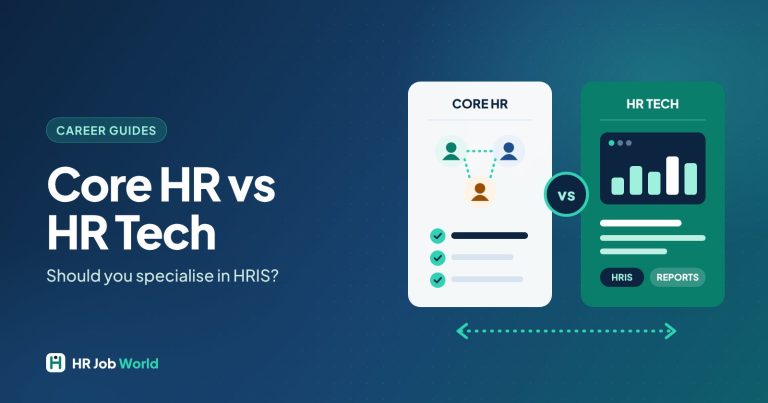
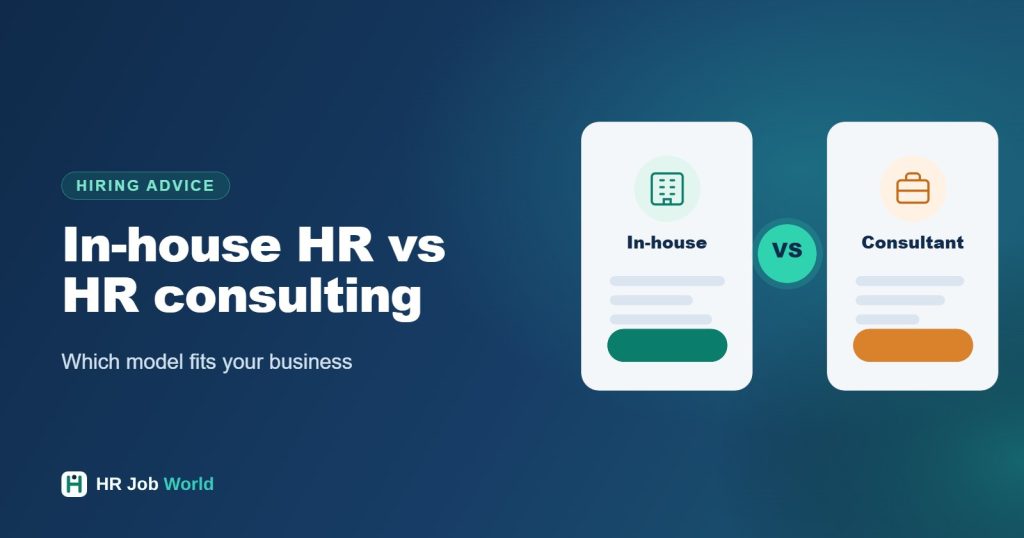
In-house HR means full-time HR staff on your payroll, embedded in your business day-to-day. HR consulting means you engage external specialists as needed, for a project, a problem, or ongoing advisory, without adding headcount. One is a fixed part of your team; the other is expertise on tap.
The case for in-house HR
An in-house team lives inside your culture. They know your people, your managers, and your history, and they’re available the moment something breaks: a resignation, a dispute, a hiring surge. Over time, they build institutional memory and own long-term workforce planning in a way an outsider can’t.
The trade-off is cost and capacity. A senior in-house hire is a fixed overhead: salary, benefits, tools, and training, and a small team can only know so much across the whole HR spectrum.
The case for HR consulting
Consultants give you senior expertise without a senior salary. You get current compliance knowledge, exposure to how dozens of other companies solve the same problem, and the flexibility to scale support up or down as needs change. An outside view is also useful; consultants aren’t tangled in internal politics, so they say what an employee sometimes can’t.
The trade-off is depth of context. A consultant won’t know your culture as intimately, and for day-to-day needs, always reaching outside can get expensive and slow.
Cost: the real difference
Think of it as fixed vs. flexible. In-house HR is a standing overhead that only makes sense once your headcount justifies it. Consulting is pay-for-what-you-need, usually cheaper for occasional access to senior expertise, but less economical if you’d be calling on it every day.
| Factor | In-house HR | HR consulting |
|---|---|---|
| Cost structure | Fixed overhead (salary + benefits + tools) | Flexible, pay-per-need |
| Availability | Immediate, on-site | Scheduled / project-based |
| Expertise breadth | Deep on your company | Broad across industries |
| Compliance | Depends on how current the team keeps | Usually up to date |
| Scalability | Slower to flex | Scales up and down fast |
| Culture fit | Strong | Needs onboarding |
| Best suited to | Stable, larger teams | Early-stage, project-based or lean teams |
When to choose which
Lean toward in-house once you’re past roughly 50 employees, hiring is steady, culture is central to your edge, or you’re in a regulated industry (manufacturing, financial services, healthcare) where HR risk is high.
Lean toward consulting when you’re a smaller or fast-scaling company, your needs are project-based (a one-off restructure, a policy overhaul, a hiring sprint), or budget won’t justify a full-time senior hire yet.
The hybrid model most growing companies land on
Plenty of mid-sized firms (roughly 50–200 people) run both: a lean in-house core for daily operations and culture, plus specialist consultants for the heavy, occasional work: compensation design, HR tech rollouts, or compliance audits. You get continuity where you need it and expert firepower where you don’t have it in-house.
How HR Job World helps, whichever model you choose
If you go in-house, you’ll need the right people, and general boards bury HR roles under unrelated applicants. Post your HR jobs on HR Job World to reach a pool that’s HR-only, with no mismatched profiles to filter out. Not sure which role to hire first? Our guide to HRBP vs HR generalist vs HR manager explains the difference.
If you go the consulting route, HR Job World also lists HR consulting jobs, so you can find experienced HR consulting talent and see which consulting and professional-services firms are hiring HR in one HR-focused place. Either way, you’re hiring from a community built around one profession.
Frequently asked questions
Is HR consulting cheaper than hiring in-house?
For occasional, senior-level needs, usually yes; you pay for expertise only when you use it. For constant daily HR work, an in-house team is typically more economical.
Can we combine in-house HR and consulting?
Yes, and most growing companies do. A common setup is a small in-house team for operations, with consultants brought in for specialist projects.
When should a startup hire its first in-house HR person?
Most do it as they approach 50 employees, or when hiring and compliance become too constant to handle through consultants alone.
The decision isn’t permanent
Your HR model should match your company as it is today, not forever. Many businesses start with consultants, then build in-house as they scale, and some do the reverse. Revisit the choice at each growth stage. When you’re ready to hire HR talent for either model, post your roles or browse HR consulting jobs on HR Job World.