Most HR professionals start in the same place: a room full of CVs, a shared mailbox, and a manager who is moving too fast to explain much. The early days of an HR career are rarely glamorous.
But the trajectory from that starting point to the C-suite is more structured than most people realise, and knowing the map makes the journey significantly easier to navigate.
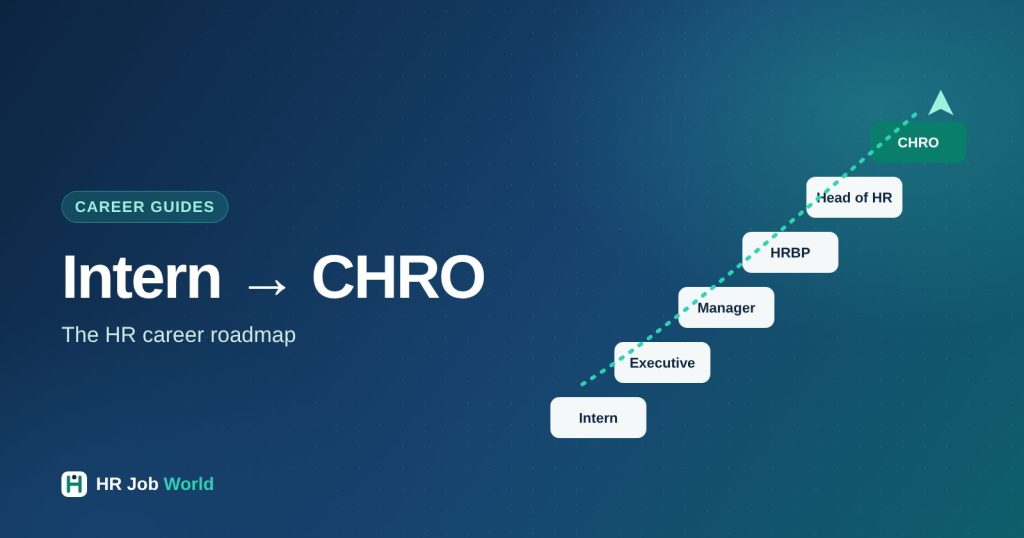
This guide breaks down the HR career path from intern to Chief Human Resources Officer, covering what each stage looks like, how long it typically takes, what skills you need to move forward, and what tends to hold people back.
Stage 1: The Starting Point (0 to 2 Years)
Typical roles: HR Intern, HR Trainee, HR Executive, Recruitment Coordinator, HR Admin
Most HR careers in India begin during an MBA or PGDM internship, or in a junior HR executive role shortly after graduation. At this stage, the work is largely operational: scheduling interviews, maintaining employee records, managing onboarding paperwork, coordinating with vendors, and supporting payroll or compliance tasks.
It feels transactional because it is. But this stage is more important than it looks. The HR professionals who grow fastest are the ones who treat this phase as an observation period, not just an execution phase. Watching how senior HR colleagues handle grievances, make hiring decisions, and communicate with leaders is genuinely educational if you pay attention.
What to focus on at this stage: getting comfortable with at least one HRIS platform, building a basic understanding of Indian labour law and statutory compliance (PF, ESI, TDS, Shops and Establishments Act), and developing reliable communication habits. Being the person who follows through consistently is a real differentiator at junior level.
Stage 2: Building Depth (2 to 5 Years)
Typical roles: HR Generalist, Talent Acquisition Specialist, HR Officer, L&D Coordinator, Payroll Executive
This is where the HR career path starts to branch. Some professionals stay broad and develop as generalists, handling a wide range of HR responsibilities across the employee lifecycle. Others begin to specialise, going deeper into recruitment, learning and development, compensation, or employee relations.
Both paths are valid, and neither forecloses the other later on. However, the professionals who tend to move fastest at this stage are those who develop genuine depth in at least one area rather than staying equally shallow across all of them.
At the two- to five-year mark, you should start to own outcomes rather than just complete tasks. That means managing a hiring pipeline end-to-end, not just scheduling, or owning an onboarding programme, not just coordinating it. The shift from doing to delivering is what most hiring managers are looking for when promoting from this level.
The organisation you work for during this stage matters more than most people realise. Companies that treat HR as a strategic function, invest in structured development, and have dedicated specialisations across TA, HRBP, and People Analytics give you compressed learning that a smaller, less structured environment simply cannot. HR Jobs Hub has put together a useful guide on the best companies for HR career growth in 2026, covering global companies like Google and McKinsey alongside Indian companies like Darwinbox and Razorpay, which is worth reading if you are thinking about where to invest the next two to three years of your career.
What to focus on: stakeholder communication, data literacy (understanding basic HR metrics, being able to explain attrition trends or time-to-hire figures), and starting to build your professional network within HR. This is also a good time to pursue a relevant certification such as SHRM-CP, NIPM, or an AIHR course if you have not already.
Stage 3: The Manager Layer (5 to 10 Years)
Typical roles: HR Manager, Senior HR Business Partner, Talent Acquisition Manager, L&D Manager, Total Rewards Manager
Getting to HR Manager or equivalent is where the nature of the work changes substantially. You are no longer just managing processes. You are managing people, advising leaders, influencing decisions, and being held accountable for outcomes at a team or function level.
This stage is where many HR careers stall, not because people lack technical skill, but because the interpersonal and political dimensions of the work become significantly more complex. Advising a business leader who disagrees with your recommendation, managing a team member who is underperforming, or navigating a redundancy situation where you know the people involved personally are all challenges that no certification fully prepares you for.
The professionals who move through this stage successfully tend to have two things: a strong point of view on people strategy that they can articulate clearly to non-HR leaders, and the emotional resilience to manage high-stakes situations without becoming either combative or overly deferential.
What to focus on: business acumen, which means understanding the P&L, knowing the commercial context your organisation operates in, and being able to connect people decisions to business outcomes. At this stage, your credibility as an HR professional is partly determined by how well you understand the business, not just the HR function.
Stage 4: Senior Leadership (10 to 18 Years)
Typical roles: HR Director, Head of HR, VP of People, Head of Talent, Head of Organisational Development
Senior HR leadership roles carry full ownership of an HR function or a significant part of it. At this level, you are setting strategy, not implementing it. You are building and developing your own team, representing HR at the executive table, and making decisions that affect the entire workforce.
The skills that matter at this stage are different from every previous stage. Technical HR knowledge is now assumed. What differentiates a strong Head of HR from a weak one is their ability to influence organisational culture, build high-performing teams, manage complexity across the business, and act as a genuine strategic partner to the CEO and board.
In India, this level typically corresponds to companies with 500 employees and above, or mid-market companies where HR has significant board visibility. Industries where senior HR roles command the most compensation and influence include IT and technology services, BFSI, pharmaceuticals, and large manufacturing conglomerates.
What to focus on: executive presence, board-level communication, and building a visible perspective on workforce trends and people strategy. Publishing thought leadership, speaking at industry forums, and being active in networks like NHRDN or People Matters significantly accelerates credibility at this level.
Stage 5: The C-Suite (15 Years Plus)
Typical roles: Chief Human Resources Officer (CHRO), Chief People Officer (CPO)
The CHRO sits on the leadership team and is accountable for the organisation’s entire people strategy. This includes workforce planning, culture, talent acquisition, total rewards, learning and development, HR technology, and increasingly, diversity, equity, and inclusion.
Getting to CHRO level is not simply a matter of seniority. Most CHROs have two things that their peers who plateau at director level do not: deep cross-functional experience across multiple HR functions over their career, and a track record of leading significant organisational change, whether through a merger, a workforce transformation, a culture reset, or a major business pivot.
In India, CHROs at large listed companies and MNCs earn INR 60 lakh to well above INR 1 crore per annum, with compensation often including equity, bonuses, and long-term incentive plans.
For those also tracking what senior remote HR leadership pays internationally, HR Jobs Hub analysed 34 US remote HR postings and found that the median pay for VP and CPO-level remote HR roles was approximately $245,000 in base salary, with director-level roles at around $166,000 and meaningful equity at the top. Useful context if you are benchmarking your own compensation or planning a move toward international or global HR leadership.
What the Whole Journey Actually Requires
Across all five stages, the HR professionals who build the strongest careers tend to share a few characteristics that no role description mentions, but every hiring manager looks for.
They are genuinely curious about the business, not just the HR function. They build relationships across the organisation, not just within HR. They take on work that is uncomfortable before they feel ready for it. And they invest in their own development with the same seriousness they bring to developing others.
One specific area worth tracking early is the AI sector. AI companies including OpenAI, Anthropic, Google DeepMind, and Microsoft’s AI division are building People functions at pace and hiring HR professionals across HRBP, Talent Acquisition, and Compensation roles, often with above-market pay and meaningful equity. HR Jobs Hub has a dedicated guide on top AI companies hiring HR professionals right now, including what roles they hire for and how to stand out as a candidate, which is a genuinely useful read for anyone thinking about where to take their HR career in the next five years.
If you are at any stage of this journey and want to see what roles are available that match where you are right now, HR Job World lists HR openings across all experience levels and functions. And if you want global and remote HR opportunities to come directly to your inbox, subscribing to the HR Jobs Hub newsletter is the easiest way to stay across the market without having to search every day.
Wrapping Up
The HR career path is long, genuinely varied, and more strategic at the top than most people imagine when they start. Every stage builds something the next one needs. The intern who pays attention becomes the generalist who understands nuance. The generalist who earns trust becomes the manager who influences. The manager who thinks commercially becomes the leader who shapes culture.
The map is there. The pace depends on you.
Frequently Asked Questions
How long does it take to become an HR Manager in India?
Most HR professionals reach manager level between five and eight years into their career, depending on the organisation size, the pace of their development, and whether they have developed specialist depth alongside generalist breadth. In high-growth companies and startups, the timeline can be shorter. In large structured organisations, it tends to be longer with a more defined ladder.
What is the difference between an HR Manager and an HRBP?
An HR Manager typically leads or oversees the HR function within an organisation, managing a team and owning operational HR delivery. An HR Business Partner works strategically alongside a specific business unit or leadership team, advising on people strategy and workforce decisions rather than managing day-to-day HR operations. In many organisations the two roles sit at similar seniority but have different orientations — this comparison of HRBP, HR Generalist and HR Manager goes through how to tell them apart from a job description.
What qualifications do I need to become a CHRO in India?
Most CHROs in India hold an MBA or PGDM with an HR specialisation from a reputed institution such as XLRI, TISS, or IIM. Beyond academic qualifications, what matters most is a track record of leading HR functions across multiple domains, experience navigating large-scale change, and the ability to operate credibly at board level. There is no single certification that makes someone CHRO-ready.
Should I stay a generalist or specialise in HR?
Both paths lead to senior roles. Generalists tend to move into HRBP and HR Director tracks, while specialists can reach senior leadership within their domain such as Head of Talent Acquisition or Head of Total Rewards. Many senior HR leaders started as specialists and broadened out over time. The strongest advice is to develop genuine depth in at least one area early, rather than staying shallow across everything.
What is the best certification for advancing an HR career in India?
For domestic corporate roles, NIPM certification and labour law qualifications are well-regarded. For MNCs and global organisations, SHRM-CP or SHRM-SCP carry strong recognition. For L&D-focused career paths, ATD CPTD is relevant. For analytics roles, AIHR’s people analytics programmes are increasingly valued. The best certification is the one that fills the specific gap in your current profile.